For many Indian students, the thought of studying abroad usually conjures images of the United States, the United Kingdom, or even Australia. Yet, in recent years, Singapore has quietly established itself as one of the strongest contenders. Why? Because it offers a fascinating balance: global standards of education, safety, multicultural vibrancy, and proximity to India. Just a five-hour flight away from Mumbai or Delhi, Singapore feels reassuringly close to home, while still providing the kind of international exposure that can transform a career.
When you land in Singapore, you’re greeted not just by the glittering Marina Bay Sands skyline but by a society that thrives on discipline, innovation, and cultural diversity. For Indian students, it’s a place where global ambitions meet Asian sensibilities. But before you imagine yourself strolling down Orchard Road after class, there’s a journey to complete—the application process. Let’s explore it step by step.
Step 1: Understand Singapore’s Education Landscape
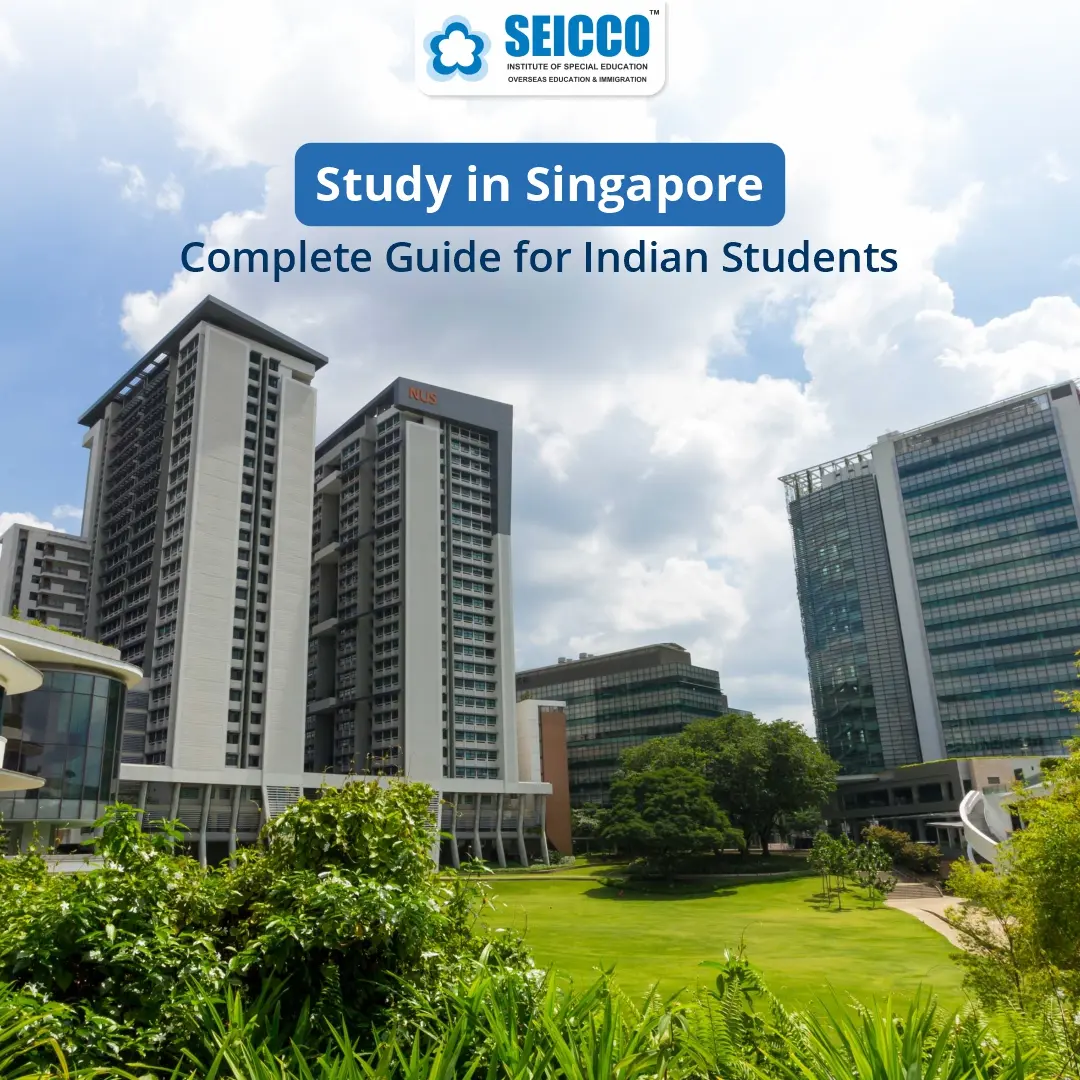
Singapore may be a small nation, but when it comes to higher education, it punches far above its weight. Two of its universities—the National University of Singapore (NUS) and Nanyang Technological University (NTU)—consistently rank among the world’s top 20. Singapore Management University (SMU), meanwhile, has carved a reputation for producing business and finance leaders.
Beyond public universities, you’ll also find private institutions and international campuses like INSEAD Business School and James Cook University Singapore, which bring a global flavor to the city-state. For Indian students, the appeal lies not just in global rankings but also in the region’s role as a financial, technological, and cultural hub.
Step 2: Choose Your Course and University
The range of courses available is extensive: Engineering, Computer Science, Business, Medicine, Life Sciences, Hospitality, Social Sciences, and Creative Arts are just a few options.
- Engineering students benefit from Singapore’s strong links with technology industries.
- Business graduates tap into the country’s status as Asia’s financial nerve centre.
- Hospitality students train in one of the world’s busiest tourism economies.
The key is alignment—choose a course that matches your long-term career ambitions. Remember, this choice is not just academic; it shapes your professional journey.
Step 3: Check Admission Requirements
Requirements differ between undergraduate and postgraduate programs, but here’s what Indian students can expect:
- Undergraduate: Good Class 12 marks (often 80% or higher), SAT/ACT scores for some programs, and IELTS/TOEFL (minimum IELTS 6.0–6.5 or TOEFL 80–100).
- Postgraduate: Strong bachelor’s degree, GRE/GMAT for competitive courses like MBA, English proficiency scores, and sometimes work experience (especially for executive courses).
For instance, NUS typically expects IELTS scores of 6.5–7.0 or TOEFL scores above 92, while NTU maintains a similar benchmark. This is important because English proficiency is non-negotiable for securing admission.
Step 4: Application Timeline
Timing can make or break an application. Singapore universities generally follow two intakes:
- August (major): Applications open in October–January.
- January (minor): Applications open in March–June.
If you’re aiming for August 2026, you should ideally prepare documents by mid-2025. Many Indian students miss deadlines simply because they underestimate how early applications need to begin.
Step 5: Prepare and Submit Documents
The documentation process is systematic. You’ll need:
- Academic transcripts and certificates.
- Test scores (IELTS/TOEFL, GRE/GMAT/SAT if required).
- Statement of Purpose (SOP) explaining your goals.
- Letters of Recommendation (2–3, from teachers or employers).
- A detailed CV or résumé (especially for postgraduate programs).
- Valid passport copy.
- Application fee (usually SGD 20–30 or ₹1,200–1,800).
A strong SOP is your personal voice—don’t treat it as a formality. It should connect your academic interests, professional ambitions, and why Singapore is the right place for you.
Step 6: Admission Offer
After submitting, shortlisted students may face an interview, often conducted virtually. Universities assess not just your scores but your overall fit. Successful applicants receive a Letter of Offer, and you’ll usually be asked to confirm your seat by paying a deposit fee of SGD 1,000–2,000 (₹60,000–1.2 lakh).
Step 7: Student Visa (Student Pass)
Here’s where Singapore stands out—it doesn’t issue a standard “student visa.” Instead, international students require a Student Pass issued by the Immigration & Checkpoints Authority (ICA).
- Universities register you in the SOLAR system (Student’s Pass Online Application & Registration).
- You complete eForm 16 online, upload documents, and pay a processing fee of SGD 30 (₹1,800).
- On approval, you pay the issuance fee of SGD 60 (₹3,600).
- Processing usually takes 2–4 weeks.
This streamlined system is one reason students find Singapore so efficient to navigate.
Step 8: Plan Your Finances
While less expensive than the US or UK, studying in Singapore still requires significant planning.
- Tuition Fees:
- Undergraduate: SGD 12,000–20,000/year (₹7.2–12 lakh).
- Postgraduate: SGD 18,000–30,000/year (₹11–18 lakh).
- Undergraduate: SGD 12,000–20,000/year (₹7.2–12 lakh).
- Living Expenses:
- On-campus housing: SGD 3,000–6,000/year (₹1.8–3.6 lakh).
- Off-campus housing: SGD 800–1,500/month (₹50,000–90,000).
- On-campus housing: SGD 3,000–6,000/year (₹1.8–3.6 lakh).
- Other Costs: Health insurance, transport, and books add another SGD 2,000–3,000/year (₹1.2–1.8 lakh).
Scholarships like the Singapore International Graduate Award (SINGA) and merit-based awards from NUS and NTU reduce the burden considerably for Indian students.
Step 9: Arrival and Orientation
Landing in Singapore is the start of a new chapter. Most universities organize orientation weeks that introduce you to academic systems, campus facilities, and student networks. This is also when you finalize your Student Pass, set up a local bank account, and explore accommodation options if you haven’t already.
The presence of Indian restaurants, temples, and cultural associations in areas like Little India ensures you’ll never feel entirely cut off from home. Yet, every MRT ride and hawker centre meal reminds you that you’re living in one of the world’s most modern, cosmopolitan cities.
Final Thoughts
Applying to study in Singapore may feel like a series of forms, fees, and formalities, but it’s more than that. It’s a doorway into a society that values hard work, multiculturalism, and academic excellence. For Indian students, it represents a rare combination: world-class education within reach of home, both geographically and culturally.
The process—from shortlisting universities to receiving your Student Pass—requires careful planning, but it is also refreshingly transparent. Once you’ve navigated the application journey, you’ll find yourself part of a vibrant community where ambition is not just nurtured but celebrated.
Quick FAQs
1. Do I need IELTS or TOEFL for Singapore universities?
Yes, unless your previous degree was taught in English.
2. Can I work part-time while studying?
Yes, up to 16 hours per week during term and full-time during vacations, provided you’re in an approved institution.
3. What is the average cost of studying in Singapore?
Around ₹7–18 lakh/year for tuition plus ₹2–6 lakh/year for living expenses.
4. How long does it take to get a Student Pass?
Typically 2–4 weeks after application.
5. Which courses are most popular for Indian students?
Engineering, Business, Computer Science, and Hospitality lead the list.